
What’s the Latest in Spirit Tech?
Spirit Tech is one of the most exciting intersections of science and consciousness. Its advent can perhaps be traced back to the 1950s-60s with the evolution of cybernetics, which included mechanical feedback systems, early neural networks, and human-machine interactions. Today, from immersive meditations to biofield imaging and light-based brain stimulation, the sector has evolved into a diverse landscape of technologies seeking to enhance mental health, self-awareness, and human potential.
I recently had the chance to experience the latest technological interventions in the field at Human+Tech Week, a gathering of Spirit Tech futurists in San Francisco. Although I walked in as a skeptic, I left with new realizations about the role of technology in not only improving human wellness but also elevating us to higher states of collective consciousness.
Here are four tools I tried.
Virtual Reality Meditation
What it is: This technology uses immersive virtual environments, usually natural landscapes, to support meditation. Early evidence points to psychological benefits including “improved anxiety, mindfulness, emotions, disease patterns, affect, stress, (presleep) arousal, meditation” and more.

My experience: Hearing visionaries like Nanea Reeves from Tripp, an award-winning VR meditation company, speak about the potential of using VR gaming and meditation for better mental health, I knew I absolutely had to experience this myself. Tripp has reportedly seen immense traction, especially with men, in improving mental health. My VR meditation experience was with another company, Cyberdelic Labs.
I sat on a chair as their CEO strapped massive goggles onto my face. They were ergonomically designed, so I didn’t feel the weight. Headphones were placed on my ears. I could choose from a wide range of settings to meditate in, from galaxies to cityscapes, with optional guidance while meditating. I selected an unguided session in a portal of nature.
Soon enough, the music and vivid, realistic visuals were enough to make me forget that I was sitting in a chair. It felt as though I was floating in the portal, a moment that truly did justice to the name, “Cyberdelics”. The experience had my complete attention. The random thoughts that usually frequent the mind when one starts meditating did not arrive.
However, after a while, I began to feel the same guilt and malaise one gets from staring at a screen for too long or doomscrolling. Since I already have a regular meditation practice, I could sense my body craving stillness and the absence of external sensory input to go deeper within. I ended my session early, removing the goggles before the 12-minute session concluded, and left feeling lower in energy than when I arrived.
Final Thoughts: VR meditation tools today might be a good way for beginners to engage with meditation, given that they enhance focus in people who struggle with attention and sitting still. It could also instantly (albeit temporarily) boost the moods of people suffering from negative emotions. However, reaching deeper states of meditation and consciousness requires sense-withdrawal (Pratyahara). This remains a purely human journey, which VR in its current form is not equipped to support.
Vibroacoustic Therapy: Healing with a SoundBed
What it is: Everything and everyone is in a state of vibration and therefore has a frequency, meaning, we are sound! Yet, the potential of sound in facilitating human healing has been underexplored in modern science. Based on the recognition that external vibration affects bodily function, Vibroacoustic therapy is a new sound technology that uses audible sound vibrations to invoke relaxation and alleviate stress. Early evidence also shows enhanced concentration.
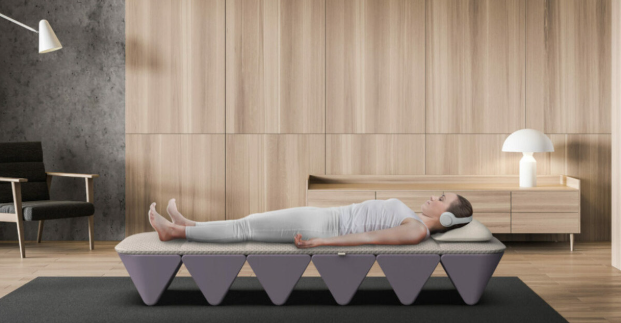
My experience: This experience surprised me the most. Having experienced authentic sound healing with bowls from reputed places in Bali and Auroville, I was unsure how healing with the Opus Sound Bed would feel. I’m generally wary of people who claim to send healing frequencies to chakras (our body’s energy centers) because, as a pranic healer, I wonder how they determine the correct frequencies for each person. So I opted for the shortest experience – a six-minute session.The founder was very kind and patiently walked me through their patent-pending technology, which consists of a bed with different vibrational zones. I lay down with headphones on as he played a song of his choosing, and the experience began.
To my surprise, the bed vibrated in sync with the song’s beats. When the intensity of the song increased, so did vibrational power. The experience turned out to be both emotional, due to the music, and energizing, thanks to the vibrations, leaving me feeling overall incredible and in awe. By the end, I felt noticeably different, both physically and mentally. While my rational side wondered whether the music played a greater role than the vibrations themselves, I couldn’t deny that I left feeling significantly better, even if I couldn’t empirically explain why.
Final Thoughts: Vibroacoustic Therapy can be highly effective for instant energy shifts, pain relief, and mood enhancement. However, as with other Spirit Tech tools, achieving deeper meditative and sustainably high-energy states still requires human training and inner practice.
Photo-biomodulation: Healing with Light
What it is: Photobiomodulation (PBM) is a procedure that uses light to modulate cellular functions and biological processes. Its non-invasive nature has led to widespread medical applications, especially in dermatology. Using PBM to improve cognitive function entails emitting specific wavelengths of light to stimulate cellular activity in the brain, promoting neuroprotection, mood improvement, focus, sleep, and mental recovery.

My experience: I put on the Neuromatrix helmet and sat on a chair. The helmet is designed to deliver specific wavelengths of light directly to the scalp and brain regions. Although some people reported noticeable cognitive improvements and feeling good, I didn’t consciously feel any changes. After about ten minutes, I developed a headache and decided to remove the helmet
Final Thoughts: Determining the right frequency and dosage for each person remains an ongoing challenge for this technology to be reliably effective across different individuals and contexts.
Gas Discharge Visualization (GDV)
What is it: GDV captures a person’s physiological and psycho-emotional status, as well as the functional state of different organs and organ systems, by measuring the electrophotonic emissions from fingertips placed on an impulse analyzer. BioWell’s GDV camera, conceived by Dr. Konstantin Korotkov in Russia, builds on the legendary Kirlian photography work at the intersection of quantum biophysics and Eastern medicine.

My experience: I placed my fingertips one by one into the BioWell device. Within minutes, it produced a 26-page report assessing my energy, stress levels, and organ imbalances. It also provided health insights drawn from Ayurveda (dosha imbalances) and Traditional Chinese Medicine (meridian-based yin and yang analysis).
Most of my readings fell within normal ranges, except for indications of energy congestion in my lower back. According to my energy medicine training, this might signal either existing or imminent lower back pain. At the time, I hadn’t experienced any pain, but, astonishingly, I began feeling discomfort in my lower back the very next day. I was stunned. Was this pain psychosomatic? Had I manifested the pain after seeing my scan, or was it going to happen anyway? Though I’m still unsure which way the cause-and-effect ran, it was my first encounter with bio-field technology like this, and I was fascinated by its possibilities.
Final Thoughts: While the comprehensiveness of BioWell’s findings can be striking, questions remain about its precision, how to interpret the data, and the direction of causality. Nevertheless, biofield technology opens up intriguing new frontiers in exploring the human body and consciousness: early detection of energetic imbalances that might precede physical illness, personalized wellness interventions based on subtle energy patterns, bridging gaps between Eastern energetic medicine and Western biomedical science, and even deepening our understanding of how emotions and consciousness influence physiological health.
Conclusion:
Exploring Spirit Tech has shown me that we’re in a fascinating era where ancient wisdom and cutting-edge technology converge. These tools hint at extraordinary possibilities, from transforming mental health to revealing the hidden patterns of our energetic selves. Yet, my experiences also reminded me that while technology can support and accelerate our journey, the deepest states of healing, awareness, and consciousness remain profoundly human pursuits, shaped by inner practice and presence.
Spirit Tech may not replace the timeless paths inward, but they can be a bridge– a spark that inspires more people to explore the vast landscapes within themselves. And perhaps that’s the greatest potential of all: using technology to expand who we become, not just individually, but as mankind.


Comments